


Altos de Chavón: a stone village above the river, and how to drive there from Punta Cana
I have driven guests to Altos de Chavón more times than I can count, and I still slow down on the last stretch to watch their faces. You come through the gates of Casa de Campo, past golf carts and trimmed hedges, and then the pavement turns to cobblestone and you are standing in a village that looks like it was lifted out of the Mediterranean four hundred years ago. It was not. Dominican artisans built it in the 1970s and early 1980s, stone by stone, on a bluff above the Chavón River. That is part of the appeal. It is a made thing, made well, and it sits about an hour and forty minutes southwest of Punta Cana. This is the day trip I recommend most often to people who want something other than beach, and it works best with your own car.
What Altos de Chavón actually is
People sometimes assume it is a private club they cannot get into. Not quite. Altos de Chavón is a working village inside the Casa de Campo resort near La Romana, on the southeast coast. There are artisan workshops, galleries, a church, a museum, restaurants, and a design school, and all of it is open to visitors who drive in. You do not need to be a hotel guest. You tell the gate you are going to Altos de Chavón, they wave you through, and you park near the top of the village.
Local stonemasons, blacksmiths, and woodworkers did the labor by hand. The result is coral stone walls, wrought iron lamps, terracotta roofs, and lanes that wind more than they need to, which is exactly how an old village should feel. It is a re-creation, and nobody pretends otherwise, but the craft in it is real.
Driving from Punta Cana to Casa de Campo La Romana
The route is simple. From the Bávaro and Punta Cana area you head west, pick up the Autovía del Coral, and follow it southwest toward La Romana. It is a toll highway, so keep some pesos handy for the booths. The road is in good shape, with sugarcane fields on both sides for long stretches. Plan on roughly an hour and forty minutes without stops. I usually leave around eight in the morning so the village is still quiet when I arrive.
A rental car is what makes this day work. Tour buses run to Altos de Chavón, but they hold you to a schedule and skip the things worth stopping for on the way. With your own car you set the pace, linger where you want, and combine the village with Higüey and La Romana itself in one loop. If you are already based on the south coast, you can also rent a car in La Romana and be at the gates in about twenty minutes.
A short stop in Higüey on the way
Well under an hour into the drive you pass Higüey, the main town of the eastern province. Most people fly right by it. I would pull off for half an hour. The Basílica de Nuestra Señora de la Altagracia is the reason. It is a modern concrete church with a tall arch you can see from a distance, and it is the most important pilgrimage site in the country. Dominicans come from every province to see the image of the Virgin of Altagracia, and the feeling inside is nothing like a tourist attraction. Park on the streets around the square, walk in, keep your voice down, and give it twenty minutes.
The town around the basilica has ordinary Dominican life going on: a market, motorbikes, colmados selling cold drinks. Grab a coffee, use the bathroom, and get back on the highway. This is one of those stops a bus tour will never give you and a rental car makes easy.
Walking the cobblestone lanes: church, museum, workshops
Once you park, everything is on foot. Start at the church of St. Stanislaus, San Estanislao, a small stone chapel that faces the main square. It is still used for weddings, and if you are lucky you will see one being set up. The plaza in front of it gives you your first proper view down to the Chavón River, slow and green-banked, far below. Walk the lanes from there. The artisan workshops are the reason the village exists, and you can watch people working leather, weaving, throwing pots, and setting stones in silver. Prices in the shops are what you would expect at a resort, but the pieces are made here, not imported.
Do not skip the Regional Museum of Archaeology. It holds a collection of Taíno artifacts from the people who lived on this island before Columbus: ceremonial seats, stone axes, carved figures, pottery. It is small and quiet and gives you a different sense of the land you have been driving through all morning. The Altos de Chavón School of Design is up here too, affiliated with Parsons in New York, and the student galleries are worth a look if they are open. The work is often better than what is in the gift shops.
The Altos de Chavón amphitheater
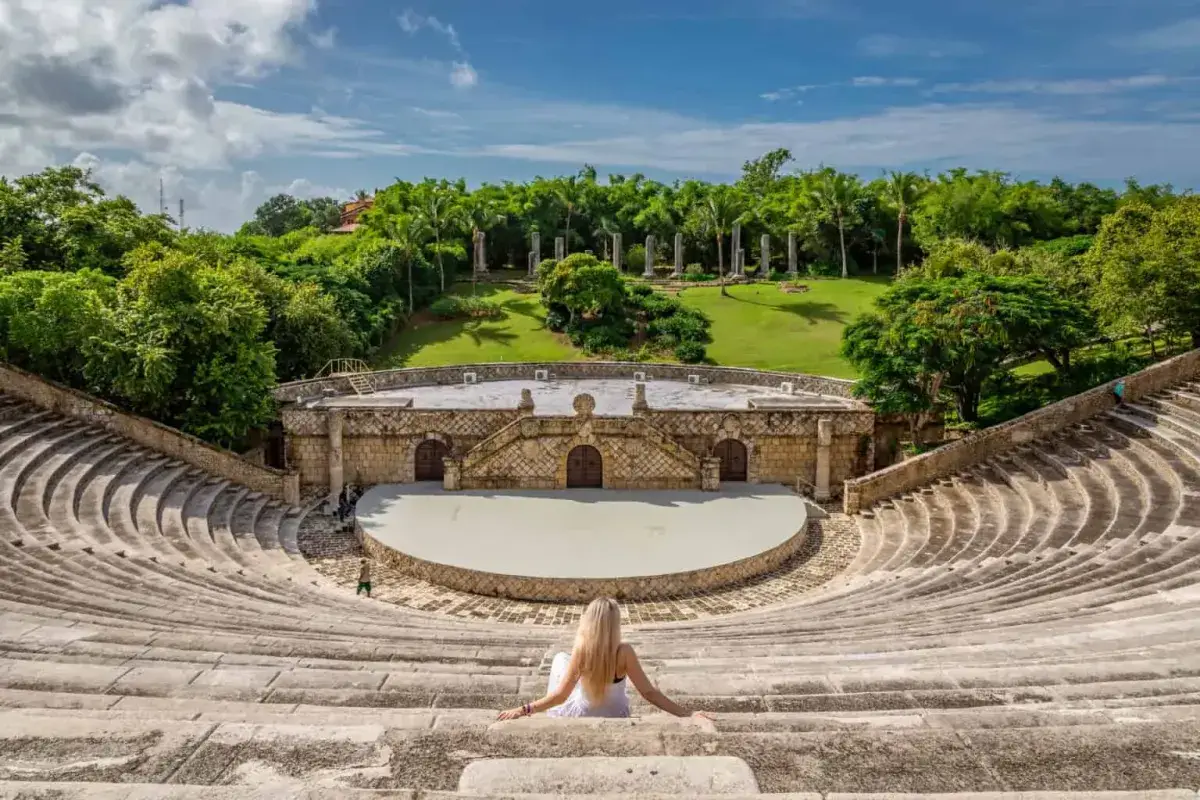
The amphitheater is the centerpiece, and it earns it. It is a 5,000-seat open-air theater built in the Grecian style, with stone tiers climbing away from a circular stage and the river valley falling off behind. Frank Sinatra opened it in 1982 with a concert Dominicans still talk about, and since then it has hosted big-name acts from around the world. When there is no show, you can walk right in, climb to the top row, and sit. Late morning the light comes in from the side and the stone is warm. It is one of the better places in the country to just stop for ten minutes.
If you want to see a concert here, check the schedule before you fix your dates, and understand that a show means a late drive back to Punta Cana. On a rental that is fine, the highway is straightforward, but factor in the night and consider a room in La Romana rather than pushing through tired.
Altos de Chavón restaurants and how to finish the day
You will be hungry by the time you have walked the village, and the restaurants here are good. La Piazzetta does Italian on a terrace over the river. Café Marietta is the breakfast and brunch spot if you arrive early, with a relaxed room and decent coffee. SBG sits up on a rooftop with the best views in the village, and it is the place for a longer lunch if you are not in a hurry. Book ahead on weekends in high season, because the tables over the river go first.
After lunch the car pays for itself again. Drop down to Bayahibe, a fishing village a short drive east, for a swim before heading home. Save Montaña Redonda near Miches for another day; it is in the opposite direction and deserves its own early start. Rental prices show when you pick your dates, and a small automatic is plenty for these roads. Pack water, sunscreen, a hat, and comfortable shoes for the cobblestones, and go early. The village is best before the buses arrive.