


Every Friday afternoon, somewhere between picking up the kids and starting dinner, I check the same thing I have checked for years: the new fuel prices. The government publishes them at the end of the week, they take effect Saturday, and by Monday the number on the pump down the road from my house has either moved or stayed put. That is the first thing to understand about gas prices in the Dominican Republic. There is no single answer to "how much is gas," only this week's answer.
I live near Bávaro, I fill up once a week, and over the years I have handed car keys to enough visiting friends and renters to know exactly where people get confused: the gallon, the grades, the attendant, the card machine. This is the page I wish I could have given them. It covers what a gallon of gas costs right now, why that number moves, and how to pull into a station, refuel, pay, and leave without a single surprise.
Why gas prices in the Dominican Republic change every week
The Ministry of Industry, Commerce and MSMEs (MICM) sets fuel prices for the whole country. Not a guideline, not a ceiling. The actual number you pay per gallon at every station, from a big highway stop to a two-pump corner station in the interior. The ministry announces the new list every Friday, and it applies from Saturday through the following Friday. Then the cycle repeats.
Why weekly? Because the Dominican Republic imports its refined fuel. Pump prices here sit downstream of three things the country does not control: the international price of crude and refined products, the cost of shipping it in, and the exchange rate between the peso and the dollar. A weekly reset lets the ministry absorb those swings in small steps instead of letting the pump price lurch around with the markets.
The part that surprises most visitors is the subsidy. The government routinely holds prices below what the market math would produce. In the week of October 17 to 23, 2026, it was subsidizing regular gasoline by roughly RD$55.65 per gallon. Add up every week of the year and the figure gets large: by mid-October 2026 the cumulative fuel subsidy for the year had reached about RD$38.2 billion pesos. That is why the pump price here feels calmer than the headlines about oil would suggest. When crude spikes, the subsidy cushions it. When crude falls, prices here tend to drift down more slowly, or simply hold.
So when you read a price anywhere online, including on this page, treat it as a snapshot with a date on it. The direction and the rough level matter more than the exact centavos.
How much is gas in the Dominican Republic right now?
Here is the reference I am using for this post, the official list for the week of October 17 to 23, 2026. That week the ministry froze prices, so they were unchanged from the week before.
- Gasolina Premium (premium gasoline): RD$358.10 per gallon
- Gasolina Regular (regular gasoline): RD$317.50 per gallon
- Gasoil Regular (regular diesel): RD$270.80 per gallon
- Gasoil Óptimo (premium diesel): RD$318.10 per gallon
With the peso running at roughly RD$60 to the US dollar in 2026, regular gasoline works out to about US$5.30 a gallon, and premium to about US$5.95. If you think in liters, regular is somewhere around US$1.40 per liter. These are approximations; the exchange rate moves, and the list resets every Saturday, so by the time you are reading this the figure may have shifted by a few pesos in either direction.
One detail that trips up visitors from almost everywhere except the United States: fuel here is sold by the US gallon. Not the liter, and not the imperial gallon. A US gallon is about 3.785 liters. Say your rental has a 45 liter tank. That is a shade under 12 gallons, so a full fill from empty on regular would come to something in the region of RD$3,800 at the October price. In practice you will rarely run it anywhere near dry, so most of my own fills land well under that.
The three grades at the pump, and the one mistake you cannot undo cheaply
Every station sells the same three families of product, with the names right on the pump: Gasolina Premium, Gasolina Regular, and Gasoil. Gasolina is gasoline. Gasoil is diesel. The words look similar enough in a hurry that I have watched people point at the wrong one.
Almost every rental car on the island runs on gasoline, regular or premium depending on what the manufacturer specifies. Diesel in a gasoline engine is not a small mistake. It means a tow, a drained tank, a flushed fuel system, and a bill that will make your vacation budget weep, and the rental company will not be sympathetic. So before you drive off the lot, open the fuel door and read the sticker, and check the rental agreement, which normally states the grade. Thirty seconds. Then, at every station, say the grade out loud and watch the attendant reach for the right nozzle.
Regular or premium? Follow the sticker. If the manufacturer calls for regular, premium is an extra RD$40 or so per gallon you do not need to spend. If it calls for premium, do not downgrade to save a few pesos on a car that is not yours.
How full-service refueling actually works
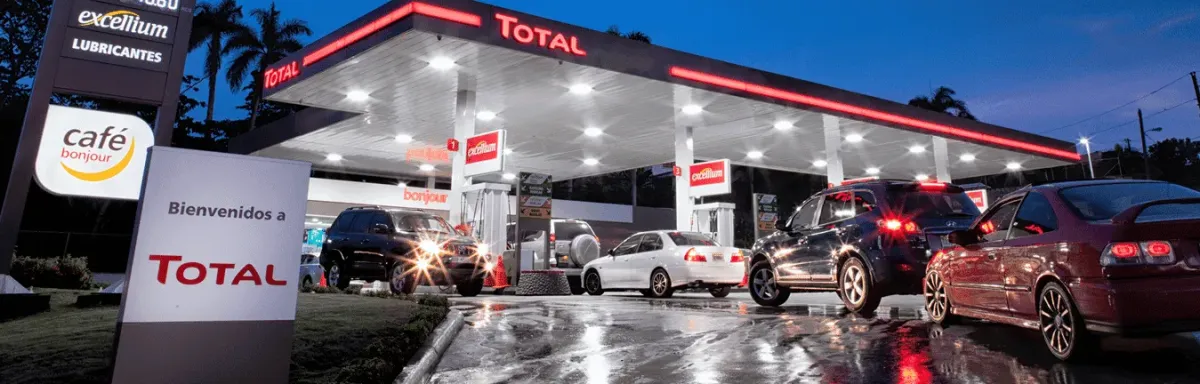
There is no self-serve here. You pull up to the pump, stop, and stay in the car, or step out and stand beside it; both are normal. An attendant, usually called the bombero, comes to your window. The word means firefighter in Spanish, which still makes me smile at the pump, but at a gas station it just means the person who does the pumping.
You tell them two things: the grade and the amount. For a full tank, say "lleno" (sounds like YEH-no). For a set amount, give a number in pesos: "quinientos de regular" is five hundred pesos of regular, "mil de premium" is a thousand pesos of premium. Pointing at the pump and holding up fingers works fine too; nobody will judge your Spanish. If the tank is nearly full and you just want to top it off, "lleno" is still the word, and the pump clicks off on its own.
The attendant opens the fuel door, or asks you to pop it, pumps, replaces the cap, and comes back to the window for payment. The whole thing takes a few minutes. It is unhurried. Nobody is in a rush, including, most of the time, the cars behind you. Once you have done it twice it becomes the most relaxing part of driving here.
Paying at the pump without getting stung
A few habits have kept me from ever overpaying at a Dominican gas station, and I pass them on to every renter.
Watch the display before the nozzle goes in. It should read 0.00. The most common problem, and it is more often a busy station's honest slip than a scam, is a new sale started on top of the previous customer's total, so the number you are asked to pay includes someone else's fuel. If the display is not at zero, say so, point, and they will reset it. Then glance at the final number when the pump stops, and at the receipt if you ask for one. The pump total already includes the 18% ITBIS, the nationwide sales tax.
Cash in pesos is the simplest way to pay, full stop. You hand over bills, you get change, and there is nothing to dispute later. I keep a few thousand pesos in the glove box for exactly this reason, and for the toll booths I will get to below.
If you do pay by card, ask for the datáfono, the portable card terminal, to be brought to your window. Do not let the card walk off to a booth. This is a normal request; attendants carry the terminal or fetch it without any fuss. When the terminal asks whether to charge you in your home currency or in pesos, choose pesos. That home-currency option is dynamic currency conversion, and the rate baked into it is worse than what your own bank will give you. The screen may present it as a convenience. It is not one.
Tipping is optional and customary at the same time, which sounds contradictory until you live here. Nobody will chase you for it, and most locals hand over a small bill, roughly RD$20 to RD$50. Tip in pesos, not dollars; small peso notes are what the attendant can actually use, and a RD$50 note is both easier and more generous than it looks on paper.
Where and when to fill up around Punta Cana
Around Punta Cana and Bávaro, finding a station is never the problem. They are plentiful along the main roads, and you will pass several between the airport and most of the hotel zones. The two things that do catch people out are hours and distance.
Fewer stations than you would expect run 24 hours. Plenty close for the night, and the ones that stay open are not always the one nearest your hotel. If you have a dawn airport run, a sunrise excursion, or you are simply the kind of traveler who likes to leave at five, fill up the night before. I say this to every guest, and about half of them learn it the hard way anyway.
Distance matters once you leave the resort corridor. Head toward Miches on the north coast, or inland toward the mountains, and stations thin out noticeably. On those roads I keep the tank above a quarter as a hard rule, and I top up whenever I pass a station with the needle anywhere near the halfway mark. The cost of an unnecessary fill is a few minutes. The cost of running dry on a quiet road at dusk is your whole evening, and possibly the next morning.
Fitting fuel into your rental car
Most rental agreements in the Dominican Republic use a same-level return policy. You get the car with a certain amount of fuel, and you bring it back with the same amount. Simple, as long as both sides agree on what the starting level was. So before you pull out of the lot, photograph the fuel gauge with the ignition on, and get the odometer in the same shot if you can. Do the same thing when you return. Two photos, thirty seconds, and there is nothing left to argue about.
When friends ask me where to rent a car in Punta Cana, my advice on the fuel side is the same whoever they end up with: confirm the grade before you leave, photograph the gauge, and keep the agreement in the glove box so the fuel policy is one page away if a question comes up at return.
Two more rental habits worth adopting. Keep some cash pesos aside for the peajes, the toll roads, because card acceptance at the booths is not something to count on, and a toll plaza is a bad place to discover that. It is also worth a two minute read of the local traffic rules before your first drive, mostly for the roundabouts and the motorbikes. And on any day trip, think of a quarter tank as empty. Fill at the last sizeable town before you leave the main highway, not at the first station you hope to find on the other side.
The short version
Gas in the Dominican Republic is not complicated once you know the shape of it. A gallon of regular was RD$317.50 in the October 2026 reference week, about US$5.30, and the figure will move a little most Saturdays. Say the grade, say lleno, watch for the zero, pay in pesos, tip a few pesos, and keep the tank above a quarter. Do that and the fuel part of your trip will be the least memorable thing about it, which is exactly how it should be.